How to assess age-friendliness in health and care sector workplaces? - NDPHS

How to assess age-friendliness in health and care sector workplaces?

13 November, 2024

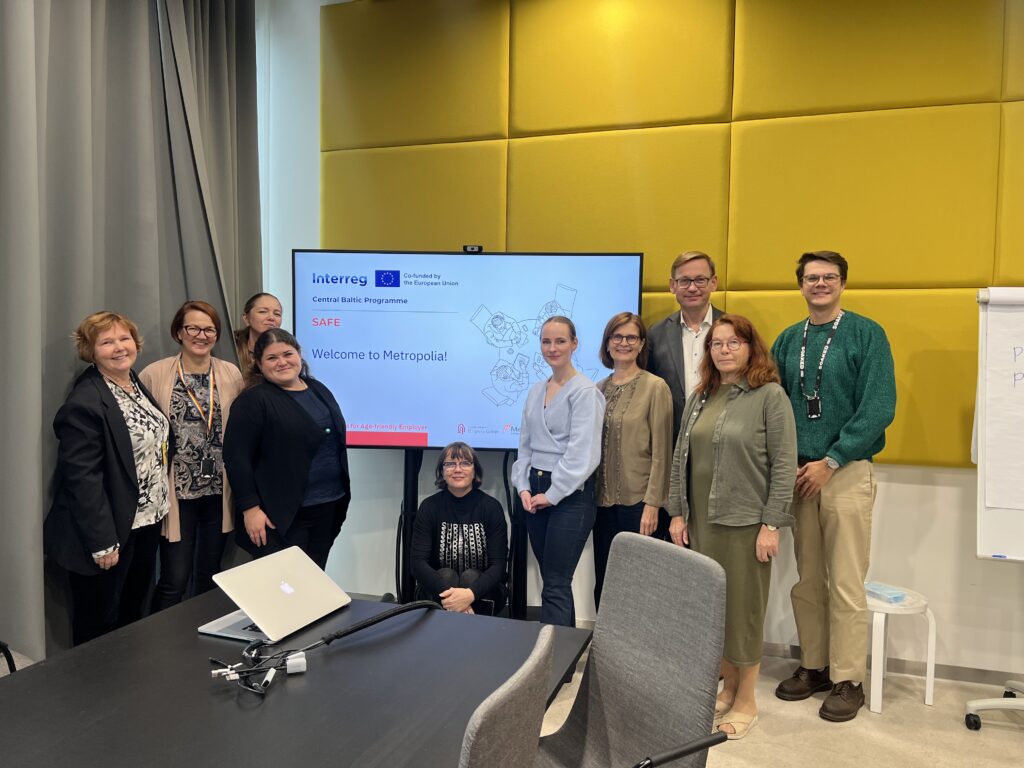
On 4-5 November 2024, the partners from the project “Solutions for Age-Friendly Employers – SAFE” gathered in Helsinki to advance the development of an age-friendly workplace self-assessment tool. Over two intensive days, the partners explored innovative age-management practices, with presentations from the Finnish start-up Nextmile and students at Metropolia University of Applied Sciences. By the end of the workshop, the partners had crafted a preliminary set of indicators for assessing age-friendliness in health and care sector workplaces. 


Nextmile unlocks the potential of senior workers

The SAFE project has partnered with the Finnish start-up Nextmile to enhance support for senior employees towards the end of their careers. CEO and Founder Antti Harjuoja kicked off the co-working days with a presentation on pre-retirement management, describing it as a strategy to extend careers and enrich the years when individuals approach their retirement age.

Harjuoja emphasised the importance of early, open communication between senior employees and managers regarding retirement plans and potential work adjustments. He acknowledged that, while retirement discussions are often sensitive, they are essential both for the employer and the senior employee.

Nextmile has joined the SAFE project team to help develop effective age management practices. The company’s expertise in the topic is invaluable to the SAFE project’s mission of fostering age-friendly workplaces.


Metropolia students propose fresh solutions for age-friendly practices

This Autumn, students from the Metropolia University of Applied Science’s Minno project course have been tasked to develop practical solutions addressing staffing shortages in the health and care sector, with an emphasis on age-friendly management practices. During the workshop, the students presented two ideas that they have developed through the Minno course: peer coaching led by a trained professional to ease workplace challenges and career path conversations between employees and employers at various career stages.

These ideas will be used as an inspiration for the SAFE model for age-friendly employers. Additional student projects will contribute further innovation proposals throughout the academic year.

Developing the age-friendliness self-assessment tool

Inspired by the insights from both Nextmile and the Metropolia students, the SAFE partners began defining indicators for the age-friendliness self-assessment tool. Partners analysed the current landscape of the health and care sector in Estonia, Finland, and Sweden, noting rising employment rates among older workers, especially women aged 60-65, in this sector. Despite cultural and system-level differences, all three countries face similar challenges with the ageing workforce and the prevailing shortage of qualified staff.

Throughout autumn, the Finnish and Estonian project partners have held focus group discussions with health and care sector organisations to gather input about the current age management practices and to explore areas in need of improvement. Simultaneously, the Swedish partner has conducted a literature review to understand the current pre-retirement policies, age management practices, and attitudes toward the older healthcare workforce in Sweden. This groundwork allowed the partners to outline key themes and indicators for the upcoming self-assessment tool.

The next phase of the SAFE project involves developing and testing the tool within health and care sector organisations in Estonia, Finland, and Sweden, with pilots planned for Spring 2025.


The “Solutions for Age-Friendly Employer (SAFE)” project joins four partners from Estonia, Finland, and Sweden. The cooperation aims to strengthen and improve employment opportunities for senior workers aged 55+ specifically focusing on the health and wellness sectors. The project is financed by the European Regional Development Fund through Interreg Central Baltic 2021-2027.

Other News
ASA Expert Group Meeting in Tallinn Explores the Future of Alcohol and Substance Use Policy in the Baltic Sea Region
The 30th Meeting of the NDPHS Alcohol and Substance Use Expert Group (ASA EG) was held in Tallinn, Estonia, on 17–18 June 2026. Experts from the Baltic Sea Region, together with representatives from WHO Europe, the Nordic Welfare Centre, NordAN, Movendi International and the NDPHS Secretariat, discussed alcohol policy, tobacco control, nicotine products, drug policy, prevention and regional public health cooperation.
26 June, 2026
Research Backs the SAFE Approach: Six Ways to Keep Experienced Nurses in Work
Based on a master's thesis and a review of international studies, the research identifies six key factors that help retain experienced nurses in the workforce: supporting physical work ability, flexible scheduling, mental resilience, a supportive work environment, recognition and role renewal, and continuous professional development. The findings reinforce SAFE's mission to create age-friendly workplaces that enable longer, healthier, and more sustainable careers.
25 June, 2026
Can Arts Improve Mental Health? Baltic Sea Region Experts Showcase Creative Solutions for Well-being
Policy Area Health of the EU Strategy for the Baltic Sea Region (EUSBSR) together with the Estonian Mental Health Coalition (VATEK), organised the Arts on Prescription (AoP) Estonian National Transfer Webinar bringing together experts, policymakers, cultural practitioners, and health professionals to explore how arts and cultural participation can support mental health and well-being and to consider what it would take to bring Arts on Prescription to Estonia.
18 June, 2026
Resilience is built, not assumed: sustaining the health and care workforce under pressure
At the EUSBSR Annual Forum 2026 in Tallinn, where resilience was largely discussed in terms of security, defence, and infrastructure, the session organised by the Coordinator for Policy Area Health - NDPHS, focused on a more fundamental issue: the people who keep systems running. The session Caring for those who care for us brought attention to the health and social care workforce, not as a supporting element of resilience, but as its core condition.
21 May, 2026
NDPHS Chair Country Norway Becomes a Full Member of the EU Strategy for the Baltic Sea Region
Following the Council of the European Union’s welcome of Norway’s inclusion in the Strategy on 5 May 2026, the European Commission adopted a Communication formalising the inclusion on 18 May. In November 2025, Norway assumed the NDPHS Chairship, the Partnership especially warmly welcomes the country as a full member of the EU Strategy for the Baltic Sea Region, further strengthening regional cooperation and shared priorities.
18 May, 2026
Entrepreneurial success and employee health in harmony – advancing the Economy of Wellbeing in the Baltic Sea Region
“A healthy enterprise requires healthy workers” highlighted Dr. Anna-Kaisa Ikonen, Minister of Local and Regional Government of Finland, at the 3rd Baltic Sea Business Day in Rostock. Her remarks set the tone for an event focused on finding the critical alignment between economic success and employee wellbeing. Policymakers and business leaders urged a cross-sector shift toward preventive health measures to combat rising sick leave and secure long-term productivity across the region.
5 May, 2026
Arts for Health and Well-being Network meets in Szczecin, Poland
ArtWell NET is an initiative financially supported by the Swedish Institute that brings together experts from the health and cultural sectors to promote the concept of ‘Arts on Prescription’. The 20–21 April event was organised in a hybrid format and brought together experts and practitioners, creating the conditions for the exchange of experiences and the development of cooperation in the Baltic Sea Region and Ukraine.
24 April, 2026
All News >