Progress Towards Age-Friendly Workplaces: Insights from the SAFE Project
7 November, 2025
A particular focus of the Helsinki meeting was placed on the development of the self-assessment tool, a cornerstone of the SAFE digital platform. The self-assessment tool is a key instrument for organisations, enabling them to assess their current level of age-friendliness and receive targeted guidance and resources for improvement. Piloting will soon begin in the health and well-being sector to test the tool in real workplace settings in Estonia, Finland, and Sweden. Complementary interviews with employers will be carried out to gain additional insights into user experiences. For more information, see our recent post: What makes a workplace age friendly, and why should we evaluate it? Challenges remain—particularly balancing comprehensive data collection with user-friendliness—but the partners have already gathered insights and tools to help organisations make meaningful changes for employees of all ages.
The visual appearance and usability of the tool are being continuously developed in close collaboration with experts from Estonia and Finland. As part of this process, Project Manager Liisa Nuutinen and Senior Project Specialist Heini Maisala-McDonnell from Metropolia University of AppliedSciences presented the concept recently in Turku as the the Tree of Age-Friendliness, which forms the visual foundation of the tool. The tree illustrates different dimensions of age-friendliness – from roots (community and inclusion) to fruits (training and learning) – symbolising growth towards more sustainable and inclusive work communities.
In addition, a Delphi panel, led by the Golden League, will be conducted to gather expert feedback on pilot activities and refine the proposed solutions for age-friendly organisations followed by an outreach and awareness campaign.
Partners also agreed on plans to present the project and its developments at several established conferences in 2026, including:
EUSBAR Annual Forum (9–10 June, Tallinn)
European Public Health Conference (10–13 November, 2026)
Estonia’s Annual Health Promotion Conference
Together, the partners are advancing toward one shared goal: Ensuring that age equality becomes the standard in workplaces, allowing the aim of age-friendliness to grow stronger across the Baltic region and beyond.
Project partners:

The “Solutions for Age-Friendly Employer (SAFE)” project joins four partners from Estonia, Finland, and Sweden. The cooperation aims to strengthen and improve employment opportunities for employees aged 55+ specifically focusing on the health and wellness sectors. The project is financed by the European Regional Development Fund through Interreg Central Baltic 2021-2027.
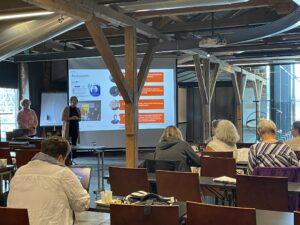
Age should not decide who gets to stay in the workforce. Working conditions and opportunities should enable people to continue contributing throughout their careers. On 6–7 October 2026, partners in the Solutions for Age-Friendly Employer (SAFE) project gathered at Metropolia University of Applied Sciences in Helsinki to exchange knowledge on longer working lives and prepare for the project’s final phase.
SchoolChanger partners met in Estonia on 6–7 October 2026 to develop practical ways to involve young people in shaping more inclusive and supportive school environments. The programme included a visit to the sensory garden at Nissi Basic School, testing board games designed to encourage creativity and empathy, and experimenting, solve problems and developing prototypes at VIVITA in Tallinn.
In her World Mental Health Day statement, Ülla-Karin Nurm, Director of the NDPHS Secretariat, calls for mental health to be considered in every ministry and town hall, with people with lived experience involved from the start. She explores how cooperation across the Baltic Sea Region can turn tested approaches into practical policy recommendations.
At the third EPIC workshop in Helsinki, occupational safety and health experts developed three project ideas to strengthen workforce resilience and crisis preparedness. Building on earlier discussions in Tallinn, they explored opportunities for transnational cooperation.
Arts on Prescription in the Baltic Sea Region has been shortlisted in the Public Sector Collaboration in Social Services category. The nomination recognises the project’s strong cross-sectoral and transnational partnership and its work to advance arts-based approaches to mental health and well-being.
The third international meeting of the Arts for Health and Well-being Network (ArtWell NET) brought partners from Ukraine, Sweden, Poland and Estonia together in Kolomyia, Ukraine. The meeting focused on how the Baltic Arts on Prescription model could be adapted to the Ukrainian context and what the wider Baltic Sea Region can learn from Ukraine’s experience of supporting mental health during wartime.
The NDPHS Secretariat in Stockholm is offering paid internships for 2026–2027. Gain hands-on experience in an international environment while contributing to public health, mental health and health-promotion activities.
Arts on Prescription has now become part of the public discussion in Estonia. At the 2026 Opinion Festival in Paide, the Estonian Coalition for Mental Health and Well-being VATEK invited representatives from healthcare, public health, culture, local government and policymaking to explore what the approach could look like in the Estonian context.
We use cookies to ensure that we give you the best experience on our website. If you continue to use this site we will assume that you are happy with it.