A Holistic Look at the Work Environment. MentalHealthMatters project at the conference on approaches to enhance employees’ well-being
 A healthy psychosocial working environment is important for a sustainable work life and essentially for more resilient communities. However, innovative and scalable approaches to address stress, burnout, chronic fatigue, and other work related challenges are still lacking. In September, we participated in the conference on Psychosocial Working Environment to raise awareness of workplace challenges and explore fair, effective, and inclusive strategies to foster a healthier and more resilient work environment. Among other outstanding speakers from the field, the NDPHS Secretariat presented the Interreg Baltic Sea Region MentalHealthMatters project’s story and results.
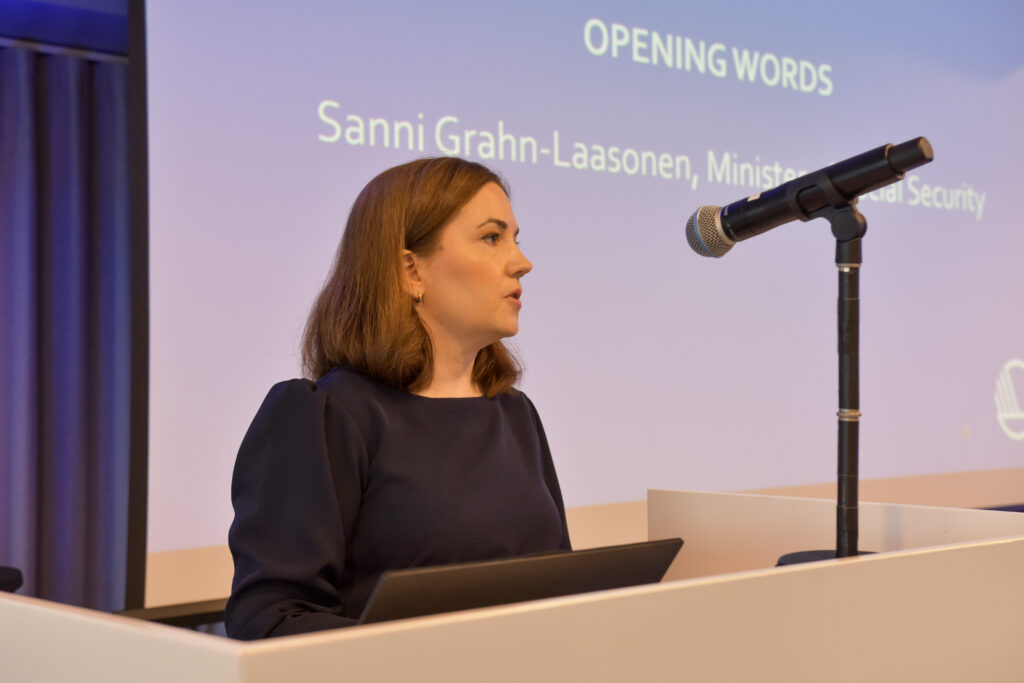
After opening words from the Finnish Minster of Social Security, Sanni-Grahn Laasonen, the conference was kicked off with Mika Kivimäki’s, University College London, University of Helsinki, Finnish Institute of Occupational Health scientific research into the topic of associations between work environment and employee well-being. Beginning with The History of Stress Research dated back to early 1900s, following with evidence from large datasets of the links between workplace and health from today, Ms Kivimäki introduced the audience with staggering data of how stress in adulthood has an important role as a disease trigger, especially in individuals with pre-existing cardiovascular or cerebrovascular disease and advanced diabetes. Despite the alarming data, Ms Kivimäki finished the presentation on a positive note and with some practical advice from Bruce Hood “The Science of Happiness – Seven Lessons for Living Well”:
- Control your attention
- Shift your mindset from egocentric to allocentric. Instead of viewing the world from your own point of view, often prioritizing your own needs or opinions, try adopting a broader perspective, considering other people’s viewpoints, needs, and the bigger picture.
- Avoid isolation
- Connect with others
- Reject negative comparisons
- Become more optimistic
- Get out of your own head
The day was continued with Annika Nyman-Koskinen’s from Regional State Administrative Agency of Occupational Safety and Health, Finland, presentation on “Observations of OSH enforcement and management of the psychosocial work environment”. Ms Nyman-Koskinen highlighted that risk evaluation is done in most of the workplaces but there is shortcomings regarding the workplace assessment that the Occupational Healthcare provider makes which often leads to insufficient actions to prevent, handle or remove risk factors. OSH Management good practice would be to identify the underlying reasons in order to target corrective action at the root of the problem and to involve the employees in matters regarding their work environment. After the insights from OSH inspector perspective, the NDPHS Secretariat’s Saara Rissanen-Fridén introduced the participants with the MenatlHealthMatters project funded by the Interreg Baltic Sea Region.
MentalHealthMatters is a recently completed project but its results and impact will resonate over time. In short, MentalHealthMatters aim is to empower employers and other workplace leaders to improve the psychosocial working environment and pave the way for sustainable system changes in Estonia, Finland, Latvia, Norway and Poland. The work starts now and to contribute to these changes, the project consortium has developed multiple resources for various stakeholders:
- The online First-Aid Kit – tailored for workplace leaders in small businesses and organisations, including employers, managers, supervisor, HR, and OSH specialists, seeking to promote mental health at work. It curates practical, easy-to-implement solutions to help address common organisational, social and structural risk factors at workplaces, which can negatively impact employees’ well-being.
- Mental Health at Work: Discussion Document on Policy Options – country-specific policy options and recommendations for addressing psychosocial factors and promoting mental health in workplaces in Estonia, Finland, Latvia, Poland and Norway. In addition, it highlights shared challenges and proposes collaborative solutions.
- Mental Health at Work: Needed Improvements (country specific) – a collection of technical country reports from Estonia, Finland, Latvia, Poland and Norway that analyse progress made and needed improvements regarding policies, regulations, data availability, and education that impact the management of psychosocial factors in the workplace.
- Mental Health at Work: Overview on Definitions, Regulations & Further Guidance – a legal annex that compiles definitions, regulations, policies, and guidance on psychosocial factors in workplaces in the Baltic Sea Region countries.
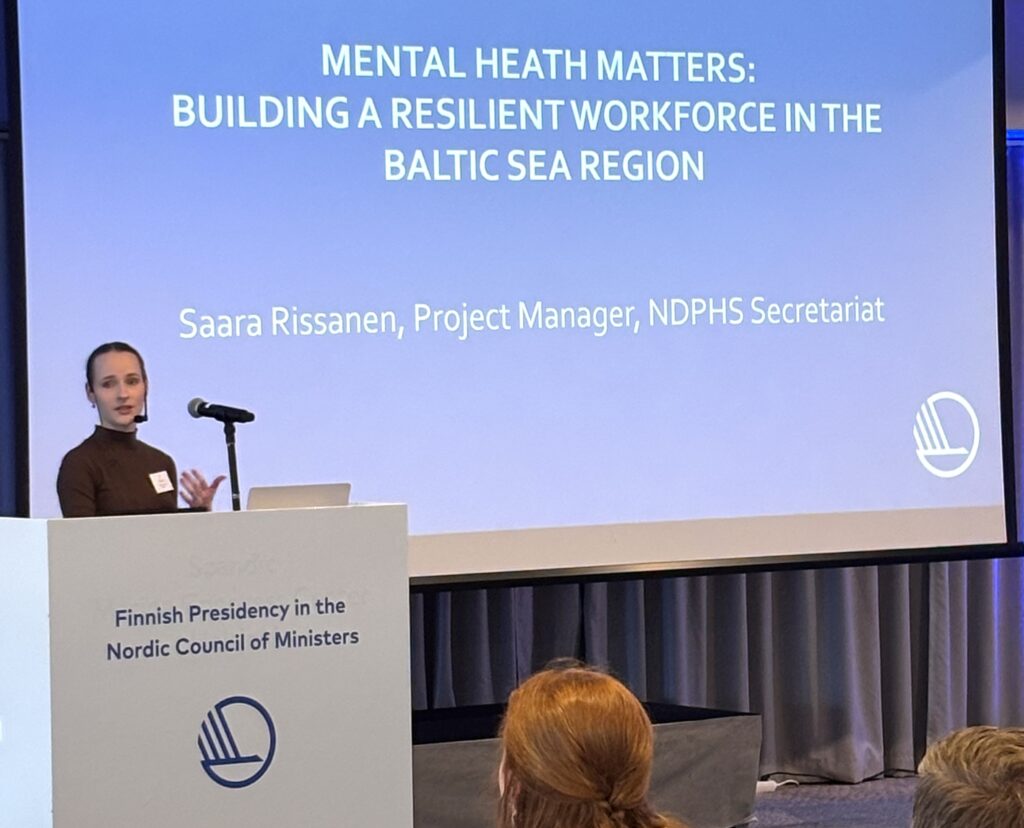
During her presentation Ms Rissanen-Fridén highlighted how transnational collaboration can be a catalyst for change. Learning from diverse policy processes and practices in neighbouring countries – sharing successes, experiences and failures, ultimately can lead to more effective implementation. The change doesn’t happen over night therefore prioritising long-term transnational professional networks, fostering a community that continues to drive change long after individual projects end is crucial.
After a buzzing networking break, the conference was continued with an energetic presentation by Reiner Rugulies from the National Research Centre for the Working Environment, Copenhagen, and the Department of Public Health, University of Copenhagen, Denmark. He provided an insightful overview of how effective actually are organizational interventions in practice. From conceptual considerations, such as individual-level vs. orgnanizational-level interventions to evaluation methods and reviews, the participants got a glimpse into what interventions have shown positive results and where gaps remain between intention and reality. The analysis covered 88 reviews and 339 meta-analysed effect estimates published between 2011 and 2024 covering a broad range of workplace health interventions. Mental health and stress reduction were the most frequently studied targets, followed by weight management and cardiometabolic health and health-related behaviours. Individual-level workplace intervention appear to work to some extent, but there is room for further improvement. It is key to address problems at the root, before they affect the individual, and aim for primary prevention. The goal would be to remove stressors in the first place, instead of training workers to handle stress reactions. Going “upstream”, to address the problem at the source would be the recommended approach, though it is not easy. Mr Rugulies emphasized that going “upstream” or implementing organizational-level workplace interventions are often highly complex and deeply context-sensitive. These interventions are difficult to conduct, but from a principal-based point of view, organizational-level workplace interventions are the right course of action. The presentation was concluded with a reminder from the famous book “Realistic Evaluation” by Ray Pawson & Mick Tilley: “Realist evaluations ask not What works? or Does this program work? but ask instead, What works for whom in what circumstances and in what respects, and how?“.
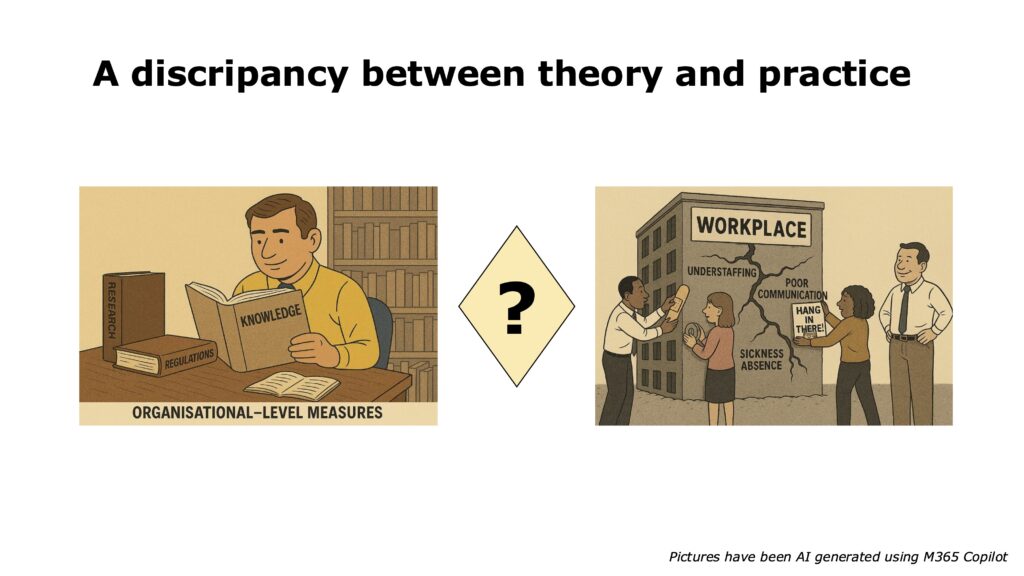
There is an intense and ongoing debate on how to evaluate complex interventions, such as organizational-level workplace interventions. Magnus Akerstrom, associate professor Research leader at the Institute of Stress Medicine, continued the topic by highlighting the barriers for implementing effective measure within the organziational and psychosocial work environment. To name a few – a discrepancy between theory and practice, lack of understanding, other priorities, initiative on hold until greater stability. To change it, an increased understanding on organisational and psychosocial work environment management is needed on multiple levels. To showcase a positive example, Johan Pastarus, Estonian Labour Inspectorate, concluded the conference with an inspiring example of Peaasi.ee initiative in Estonia, launched in 2021. It is a structured, applicable system to raise awareness and support mental well-being at work and provides organizations with trainings, tools, and guidelines. Peaasi.ee didn’t stop there and has established a recognition label. The label is awarded to employers who systematically support mental well-being. Over 90 organizations has joined Peaasi.ee by 2025 and it has become a pride to carry the label which has also shown a positive effect in new talent attraction in the job market. The progress might be slow but it is happening. In Estonia, the Occupational Health and Safety Act includes the obligation to assess psychosocial hazards as part of the work environment risk analysis.
Conference participants agreed – psychosocial hazard and risks should be prioritized equally with physical safety. The NDPHS Secretariat and the MentalHealthMatters project team extend our gratitude to the organizers for the invitation, and we look forward to continuing the work on mental health at work.