Age-Friendly by Design: Why Employers Need SAFE Solutions
 “Solutions for Age-Friendly Employer” (SAFE) is a three-year project funded by the Interreg Central Baltic Programme and aimed at employers in the health and wellbeing sector. The goal of the project is to enable employers to analyse their organisation and, based on the self-assessement results, access relevant recommendations and guidance materials to improve age-friendliness in both the working environment and management practices.
The driving force behind this initiative is the rapidly changing age structure of Estonian and the entire Nordic-Baltic region society. With the growing 55+ age group significantly impacting the labor market, public services, and community functioning, the SAFE project—a three-year initiative funded by the Interreg Central Baltic Programme—aims to help employers in the health and wellbeing sectors analyze and improve their age-friendliness through a digital self-assessment platform. The training was designed to share critical insights on work organization, awareness surrounding the retirement process, principles of inclusive spatial design, and the vital role of maintaining social relationships. The day featured presentations from leading experts who highlighted different facets of age-friendly management:
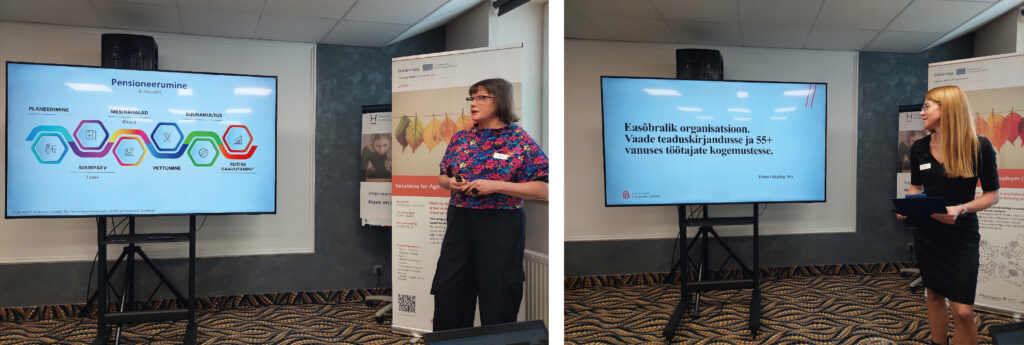
SAFE project representative Tiina Tambaum (Head of the MA programme “Community Work in an Ageing Society” and lecturer in social gerontology at Tallinn University Haapsalu College) highlighted the importance of conducting effective dialogues within organisations and supporting employees through life transitions. She stressed that organisations should consider normal ageing and adapt work environments and processes to employees’ needs. Retirement is a gradual process rather than a single event and, statistically, has a stronger impact on men, whose social networks often centre on the workplace. This transition may coincide with other major life changes, such as caring for relatives, becoming a grandparent, or losing a partner. Ideally, preparation for retirement should begin around ten years before pension age, involving both the employee and the employer. As retirement reshapes not only work but also identity and daily routines, early discussions and careful planning are essential to provide emotional and financial stability.
Triinu Lillepärg (Senior Specialist and In‑house Trainer at the Estonian Unemployment Insurance Fund, with an MA in “Community Work in an Ageing Society) introduced her recently completed master’s thesis, which explores organisational culture that supports employees of all ages, including those aged 55+, drawing on scientific literature and the example of the Estonian Unemployment Insurance Fund. The research shows that age-friendly organisations offer training and development opportunities, flexibility, health support, inclusion and recognition, fair treatment, and a culture that values diversity. Both the physical and social work environment, as well as work organisation, play a significant role.
Her findings confirm that these theoretical principles reflect the actual needs and expectations expressed by 55+ employees. While many age-friendly characteristics were identified as organisational strengths, better workload balance emerged as a key area for improvement, as high work intensity is a major reason for early retirement in this age group. Sustainable health benefits and tenure-related incentives help sustain motivation. Overall, the principles of an age-friendly organisation largely align with universal good employer practices and benefit employees of all ages.
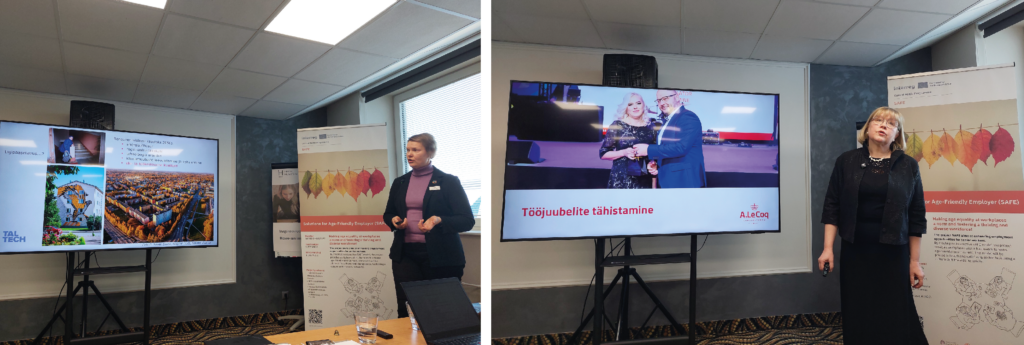
Katrin Lember (Director of Human Resources and Sustainability at A. Le Coq, lawyer (University of Tartu), and member of the Estonian Quality Association) presented the example of A. Le Coq and how the company engages and supports its older employees, including those who have retired. The average employee age is 43.3 years, with 20% aged 55 and above. To strengthen intergenerational cooperation, the company offers team trainings that promote understanding and mutual support. IT training is available to all staff and is especially popular among 55+ employees. Flexible working arrangements, such as a four-day workweek or part-time schedules, are offered.
Employee recognition is also a priority: from their tenth work anniversary, staff receive personalised gifts. Additionally, the company runs a club for former employees, “Humal,” which organises social gatherings, trips, and activities. Retired employees can continue contributing through occasional tasks, such as assisting with inventory or covering shifts during holiday periods.
Sirle Salmistu (Senior Lecturer at TalTech Tartu College, landscape architect and urban planner, Chair of the IFLA Programme on Age-Friendly Communities and Landscapes) addressed the WHO framework for creating age-friendly cities and communities, emphasising that quality of life depends on both the physical and social environment. Principles of inclusive design help create spaces that suit people with diverse abilities. Both outdoor and indoor environments should be viewed from the user’s perspective, focusing on flexibility, safety, intuitive movement, and supportive choices. Social spaces are just as important as physical accessibility. The quality of public space reduces loneliness and strengthens community ties. Supporting ageing in place requires accessible services and environments. Clarity along care pathways is also essential—without it, even good services may fail to reach those who need them.
During the second half of the day, the SAFE project team introduced the piloting process, explaining how to complete the self-assessment questionnaire and apply the recommended solutions. The event concluded with a practical panel discussion featuring healthcare leaders Dr. Mart Kull (Viljandi Hospital), Helina Andresen (Hoolekandeteenused), and Kadri Englas (Haapsalu Neurological Rehabilitation Centre).
The resounding message from all speakers was clear: workers aged 55+ are a motivated, experienced, and invaluable resource in the Estonian labor market. Fostering an age-friendly environment is no longer just a social responsibility, but a strategic advantage for employers.
Project partners

The project is financed by the European Regional Development Fund through Interreg Central Baltic 2021-2027